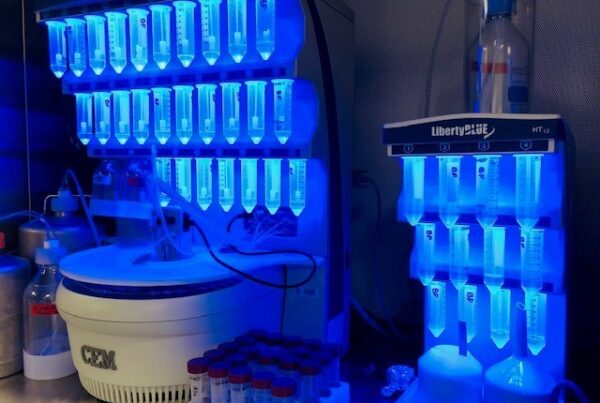
Introduction: Why Peptide Quality Testing Matters
As interest in peptide research continues to grow, one of the most important questions researchers and customers ask is: How do you verify peptide quality?
A peptide product is not evaluated only by appearance, packaging, or product information. Professional peptide manufacturing requires analytical testing, quality control procedures, and careful review to ensure consistency and reliability.
At Peptiqo, quality control is an important part of our manufacturing and procurement process. Our approach combines internal analytical testing, batch review procedures, and additional independent verification when appropriate. We provide customers and research partners with access to peptide products, educational resources, and transparent information about our quality approach.
Peptide quality control is especially important because quality cannot be determined from appearance alone. Two peptide samples may look virtually identical while producing very different analytical results. This is why we believe testing should form part of the decision-making process throughout the supply chain, rather than relying solely on supplier documentation or assuming that a previous successful batch guarantees the quality of the next one.
Our quality control process also extends beyond products manufactured directly for Peptiqo. Like many companies operating within the peptide industry, we work with external suppliers for certain raw materials, peptide APIs, and other components. Incoming materials therefore need to be evaluated with the same critical approach. Analytical methods such as HPLC and LC-MS give us additional information that can be used to assess purity, confirm identity, compare batches, investigate unexpected results, and determine whether a product should move forward in our quality process. When necessary, selected samples are also submitted to independent third-party laboratories for additional verification.
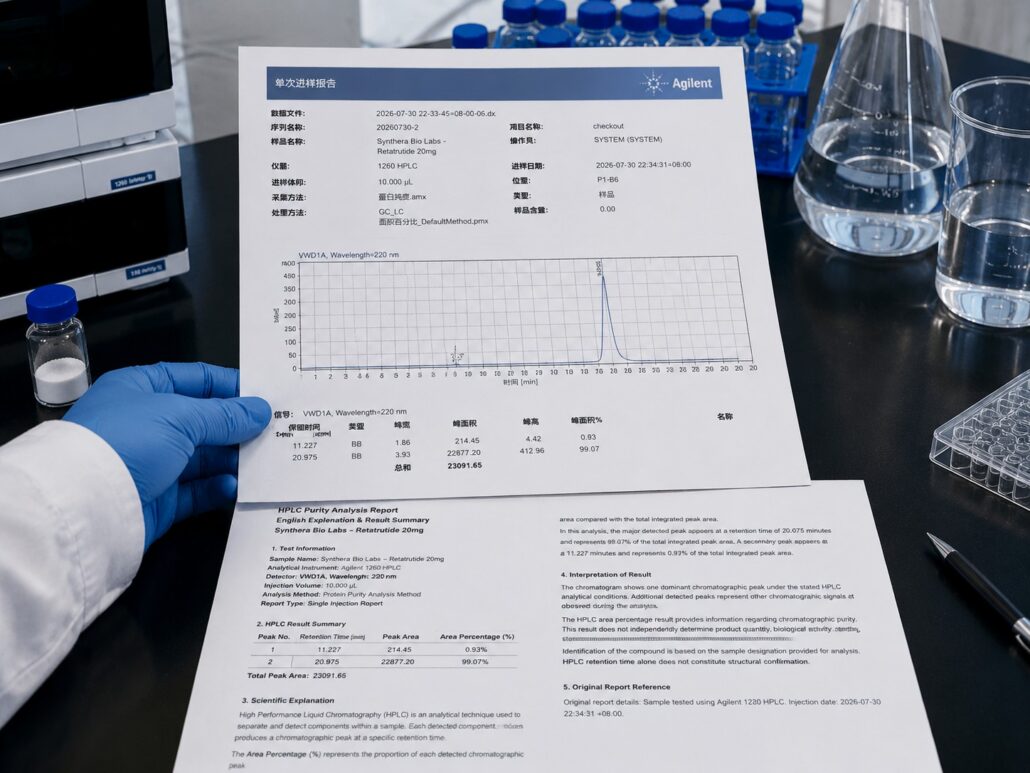
Example of internal HPLC analysis performed on Synthera Biolabs Retatrutide 20mg. The report shows the chromatographic profile and area percentage analysis used during internal quality control review.
What Is HPLC Testing?
High Performance Liquid Chromatography (HPLC) is one of the most commonly used analytical techniques for evaluating peptide purity.
HPLC works by separating components within a sample based on their chemical properties. When the sample passes through the system, different components produce detectable peaks at different retention times.
The size of each detected peak is analyzed to determine the relative proportion of components present in the sample.
In peptide analysis, HPLC is commonly used as part of quality control procedures to evaluate chromatographic purity and identify whether the sample shows a dominant peptide peak under the tested conditions.
Understanding an HPLC Chromatogram
An HPLC chromatogram is a visual representation of the detected components in a sample.
A main peak typically represents the primary component being analyzed, while smaller peaks may represent other detected components.
It is important to understand what HPLC testing tells us. In our quality control process, HPLC is primarily used to evaluate the purity of the substance being tested. The chromatogram shows how much of the detected material is represented by the main component compared with other detectable components or impurities under the specified analytical conditions.
A result showing a very high main-peak percentage therefore provides useful evidence of chromatographic purity, but purity alone does not confirm that the substance is definitely the intended peptide. This is an important distinction in peptide quality testing. A sample can potentially show a high level of purity while still requiring additional analytical testing to confirm its molecular identity.
For this reason, HPLC forms one part of our broader quality control process. We use additional analytical methods, including LC-MS (Liquid Chromatography–Mass Spectrometry), where appropriate to help confirm that the substance being analyzed corresponds to the expected peptide. In simple terms, HPLC helps us answer “How pure is the sample?” while LC-MS helps us answer “Is this the substance we expect it to be?”
At Peptiqo, we publish HPLC chromatograms and purity data for our research peptides so customers can review analytical evidence before purchasing. View our GHK-Cu 50mg HPLC chromatogram and purity report.
What Is LC-MS Testing?
Liquid Chromatography–Mass Spectrometry (LC-MS) is an analytical technique used to help identify and characterize the substance being tested. In peptide quality control, it provides information that complements HPLC purity testing.
LC-MS combines two analytical techniques. The liquid chromatography (LC) stage separates components within the sample, while the mass spectrometry (MS) stage analyzes those components according to their mass-to-charge ratio. This produces a molecular profile that can be compared with the expected characteristics of the peptide being tested.
This is particularly important in peptide testing because a high HPLC purity result does not, by itself, prove that the main component is the correct peptide. A sample could potentially produce a very clean chromatogram with a high main-peak percentage while still requiring confirmation that the substance represented by that peak has the expected molecular identity.
Mass spectrometry provides another layer of analytical evidence. By examining the molecular signals detected in the sample, the laboratory can determine whether they are consistent with the expected peptide. Peptides can produce several different charged ions during mass spectrometry, so the resulting spectrum may contain multiple related signals rather than a single peak corresponding directly to the peptide’s full molecular weight. These signals can be interpreted together to support identification of the compound.
At Peptiqo, LC-MS therefore serves a different purpose from HPLC within our quality control process. HPLC helps us evaluate the chromatographic purity of a sample, while LC-MS helps us determine whether the substance being analyzed is consistent with the peptide we expect it to be.
Using these methods together gives us a more complete picture than relying on either test alone. A strong HPLC result provides evidence about purity, while LC-MS provides additional evidence about identity. This combination is an important part of how we evaluate peptide batches during our internal quality control and procurement processes.
Comparing a Sample With a Known Reference
Another important part of analytical identification can be comparison with a known reference standard. Where an appropriate reference standard is available and the testing method calls for it, the laboratory can compare characteristics of the unknown sample with those of a known, authenticated substance.
This provides an additional point of reference when determining whether the material being tested is consistent with the expected peptide. Depending on the analytical method, laboratories may compare factors such as molecular mass, mass spectral patterns, fragmentation data, and chromatographic retention behavior with a reference standard or established reference data.
However, it is important to distinguish this from a basic LC-MS measurement. LC-MS does not automatically mean that every sample has been physically tested side-by-side against a certified reference specimen. In many cases, identification is based on whether the measured molecular data agrees with the known or theoretically expected characteristics of the target peptide.
When a validated reference standard is used, comparison against that known material can provide an additional level of confidence in the identification process. This is why the exact analytical method and laboratory report should always be considered when interpreting LC-MS results rather than assuming that all LC-MS testing follows exactly the same procedure.
Peptiqo Internal Quality Control Process
At Peptiqo, quality control is not based on a single test or certificate. Our quality workflow uses multiple analytical checkpoints designed to evaluate both the purity and identity of the peptides we manufacture or procure.
Following finished vial production, representative samples are selected for internal analytical testing. Depending on the product and testing requirements, this may include HPLC analysis to evaluate chromatographic purity and LC-MS analysis to help confirm that the molecular characteristics of the sample are consistent with the expected peptide.
The results are then reviewed as part of our batch approval process. Rather than looking only at whether a report shows a high purity percentage, we consider the available analytical information together. For example, an HPLC result can indicate that a sample contains a highly dominant component, while LC-MS can provide additional evidence that the detected substance is consistent with the peptide we expect it to be.
This creates an important quality checkpoint before a batch moves forward. If analytical results are inconsistent with our expectations, show unexpected peaks or molecular characteristics, or otherwise raise concerns, the batch can be held for further investigation rather than automatically being approved.
Our quality control process also applies to materials obtained through our supply chain. Peptide manufacturing can involve externally sourced raw materials, peptide APIs, and other components, and supplier documentation alone does not always provide the complete picture. Analytical testing gives us an additional way to evaluate incoming materials and investigate potential quality issues when they arise.
After internal review and batch approval, selected products may also be submitted to independent third-party laboratories for additional verification. Third-party testing provides another layer of analytical evidence and helps us compare our internal quality findings with results obtained independently.
Our goal is not simply to produce or procure peptides and generate certificates. It is to build a documented, repeatable, and transparent quality control process in which analytical results are reviewed, questionable batches are investigated, and quality issues can be traced back through the supply chain when necessary.
Batches moving through our quality control process are documented to support traceability and ongoing quality review. View our GHK-Cu 50mg third-party verification report.
What Happens When a Peptide Batch Does Not Pass Quality Control?
Quality control is not only about documenting successful test results. An equally important part of any serious quality system is determining what happens when a batch produces an unexpected result or does not meet established quality requirements.
No responsible manufacturing or procurement process should be built on the assumption that every batch will always meet specification. Peptide production involves multiple stages, raw materials, processes, suppliers, and analytical variables. From time to time, testing may identify a result that requires further investigation. The important question is not whether a company can claim that this never happens, but whether its quality system is capable of identifying the problem and preventing questionable material from moving forward.
At Peptiqo, when a batch does not meet our internal quality requirements, it is held and not approved for release. The analytical results are reviewed and, where appropriate, additional testing may be performed to better understand the cause of the unexpected result.
We also retain the affected material and associated documentation as part of our quality records. Keeping the physical sample together with its analytical evidence provides traceability and allows us to refer back to the batch if further investigation is required.
This is particularly important because our quality control process extends into our supply chain. Like other companies operating in the peptide industry, we may procure raw materials, peptide APIs, and other components from external suppliers. If testing indicates that an incoming material may not meet the expected specifications, retaining the sample and analytical documentation gives us evidence that can be presented to the supplier and used as part of an investigation.
Rather than simply discarding a failed or questionable batch and moving on, we want to understand why the result occurred. Was there an issue with the incoming material? Was there a production or handling problem? Does the sample require additional analysis? Is further discussion with the supplier necessary?
This approach also creates valuable historical quality information. Over time, documented test results can help identify recurring issues, evaluate supplier performance, compare batches, and improve procurement and manufacturing decisions.
For us, a failed quality test is therefore not something to hide. It is precisely the type of result that demonstrates why quality control exists in the first place. A meaningful QC system should be able to identify questionable material, prevent its release, document what happened, and use that information to improve future quality.
Internal Testing and Independent Verification
Internal quality control is the foundation of our verification process, but we also recognize the value of having analytical results independently verified.
For selected products, Peptiqo submits samples to independent third-party laboratories for additional testing. This provides another layer of verification because the analysis is performed outside of our own internal quality control environment. It also gives us an opportunity to compare independent analytical findings with the results generated through our own testing process.
Third-party testing is particularly valuable for our most popular products, products where customers specifically request independent verification, and situations where additional analytical confirmation is appropriate. As independent laboratory testing requires additional time, sample preparation, international shipping, and testing resources, it is not practical to submit every individual production batch for external analysis. Instead, third-party testing forms part of a broader quality strategy alongside our internal HPLC and LC-MS testing, batch review, documentation, and supplier quality controls.
Importantly, we do not view a third-party Certificate of Analysis (COA) as a replacement for internal quality control. A third-party report represents the analysis of a particular submitted sample at a particular point in time. It is valuable independent evidence, but it should form part of a wider quality system rather than being treated as the entire quality system itself.
Our objective is to continue expanding independent verification across our product range while maintaining strong internal analytical controls as the first line of quality evaluation.
Our products are independently verified by international laboratories such as Janoshik and Freedom Diagnostics and COA’s and other info are posted on the product page, as can be seen on the page for GHK-Cu 50mg.
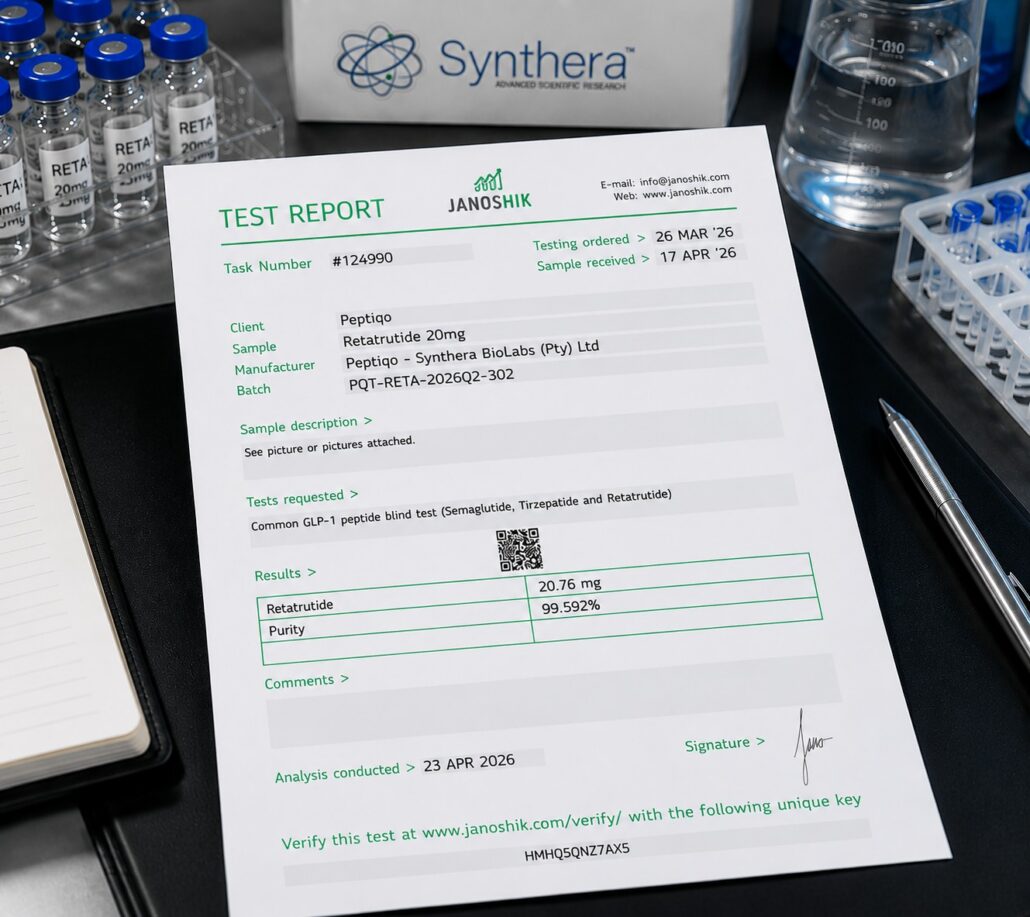
Example of third-party peptide testing for Retatrutide 20mg showing independent purity analysis and verification results.
Why Transparency Matters in the Peptide Industry
As the peptide industry continues to grow, customers are increasingly looking beyond price, packaging, and product availability. They want to better understand where products come from, how they are evaluated, what analytical methods are being used, and what happens when something does not meet expectations.
We believe this is a positive development for the industry.
At Peptiqo, we believe quality should not be represented by a single purity percentage, one Certificate of Analysis, or a collection of successful laboratory reports. A meaningful quality system involves manufacturing and procurement controls, analytical testing, batch review, documentation, independent verification where appropriate, and procedures for dealing with non-conforming materials when they are identified.
Transparency also means being realistic about what individual analytical tests can and cannot demonstrate. HPLC provides important information about chromatographic purity, while LC-MS provides additional information that can help confirm molecular identity. Independent laboratory testing provides another layer of verification. Each contributes different information, and the strongest conclusions come from considering the available analytical evidence together.
Ultimately, quality control is an ongoing process rather than a one-time event. Our objective at Peptiqo is to continually strengthen that process, expand the analytical information available for our products, document both successful and non-conforming results, and provide customers and research partners with a clearer understanding of how we approach peptide quality.
For us, transparency does not mean claiming that problems can never occur. It means having systems designed to detect problems when they do occur, prevent questionable material from moving forward, investigate the cause, document the findings, and use what we learn to continuously improve our quality standards.
Quality Control Across Our Supply Chain
Like many companies operating within the biotechnology and peptide industry, Peptiqo works with a network of manufacturing and supply partners. Depending on the product, this can include externally sourced raw materials, peptide APIs, or finished peptide products produced by qualified suppliers.
For us, sourcing a product from an external manufacturing partner does not remove our responsibility for quality. Supplier documentation is an important starting point, but it is not necessarily the end of the verification process. Products entering our supply chain can be subject to our own analytical review and quality control procedures, including HPLC and LC-MS testing where appropriate.
This is also one of the reasons we maintain records of non-conforming or failed batches. If testing identifies a problem with material supplied by an external partner, we retain the relevant sample, analytical results, and supporting documentation. This evidence can then be used to investigate the issue with the supplier, request corrective action, and evaluate whether that supplier should continue to form part of our approved supply chain.
Over time, these records also help us evaluate supplier performance. A supplier should not be judged only by the certificates provided with a shipment, but by the consistency of the materials received and how effectively any quality issues are resolved when they occur.
Our objective is therefore not to claim that every component of every product originates from a single facility. Modern peptide production can involve a specialized supply chain. Our responsibility is to understand that supply chain, evaluate the materials and products entering it, identify problems when they occur, and maintain quality controls over the products ultimately supplied through Peptiqo.
Conclusion: Quality Is a Process, Not a Certificate
Peptide quality testing is an essential part of responsible peptide manufacturing and procurement. No single test, purity percentage, or Certificate of Analysis can provide the complete picture. Meaningful quality control comes from combining appropriate analytical methods with documented procedures and informed review of the results.
At Peptiqo, our approach uses methods such as HPLC to evaluate chromatographic purity and LC-MS to help confirm molecular identity, together with batch review, supplier quality controls, and independent third-party verification where appropriate. Each of these provides a different piece of information and contributes to a more complete understanding of the material being evaluated.
Just as importantly, quality control must have consequences. When a batch produces unexpected results or does not meet our quality requirements, our responsibility is to identify it, prevent it from moving forward, retain the relevant samples and documentation, investigate what happened, and use those findings to improve future manufacturing and procurement decisions. Where an issue can be traced to an external raw-material, API, or manufacturing supplier, the analytical evidence also allows us to address the problem directly with that partner.
Synthera Biolabs is the company behind these manufacturing, procurement, supply-chain, and quality-control activities, while Peptiqo is our registered brand through which we provide peptide research products, information, and support to customers and research partners. Maintaining that connection between the technical side of our operations and the Peptiqo brand is an important part of our commitment to transparency.
We do not believe responsible quality control means claiming that problems never occur. It means building systems capable of detecting problems when they do occur and taking appropriate action.
As the peptide industry continues to develop, we believe quality, traceability, analytical verification, and transparency will become increasingly important. Our objective is to continue strengthening these processes, expanding our testing capabilities, and providing clearer information about how the products supplied through Peptiqo are evaluated.
For us, quality is not simply a number printed on a laboratory report. It is an ongoing process of testing, verification, documentation, investigation, and continuous improvement.
Have questions about our testing process? [Browse our research peptide catalog] or [contact our team] for more information about batch-specific testing and COA availability.
FAQ: Peptide Quality Testing
What is a good peptide purity percentage for research?
For most research applications, peptide purity of 95% or higher is generally considered acceptable, though the exact threshold depends on the study type. Higher-purity peptides (98–99%+) are typically preferred for in-vitro or cell-based research where impurities may interfere with results.
- 95–97%: Common for general research and binding studies.
- 98–99%+: Preferred for cell culture, receptor studies, and sensitive assays.
- >99%: Often sought for reference standards or when maximum consistency is required.
Having said that, there is no single peptide purity percentage that is appropriate for every research application. Required purity depends on the peptide, analytical objective, experimental design and applicable specification. Purity figures should also be interpreted alongside identity testing and the analytical method used.
At Peptiqo, we target high chromatographic purity in our internal testing, but we also review the full analytical profile, not just the percentage, before approving a batch for release.
What does HPLC 99% purity actually mean?
HPLC 99% purity means that 99% of the detectable material in the sample is represented by the main chromatographic peak under the specific analytical conditions used. It does not mean the sample is 99% peptide by total mass, nor does it confirm that the main peak is the correct peptide.
- HPLC measures area percentage, not absolute mass percentage.
- The result is specific to the detection method and conditions used.
- A sample can show 99% purity and still require identity confirmation (via LC-MS) to prove it is the intended peptide.
This is why we view HPLC as one component of quality control rather than the final word on a product’s suitability.
How is LC-MS different from HPLC?
HPLC evaluates purity; LC-MS evaluates identity. HPLC separates components and measures how much of the sample is represented by the main peak. LC-MS adds a mass spectrometry stage that analyzes the molecular mass-to-charge ratio of those components.
HPLC and LC-MS answer two fundamentally different questions in peptide quality testing. HPLC is used to evaluate chromatographic purity — it separates the components in a sample and measures what percentage of the detectable material is represented by the main peak. In other words, it tells you how pure the sample is, but it cannot confirm on its own whether that dominant peak is actually the peptide you ordered. LC-MS, by contrast, combines liquid chromatography with mass spectrometry to analyze the molecular mass-to-charge ratio of the sample’s components. This allows it to confirm whether the molecular characteristics match the expected peptide, effectively answering the question of identity rather than purity. For this reason, HPLC shows you the chromatographic purity expressed as an area percentage, while LC-MS provides molecular weight data and identity signals that verify the substance is what it is claimed to be. Used together, these two methods give a far more complete picture than either could provide alone.
We use both methods together: HPLC to assess chromatographic purity, and LC-MS to help confirm that the detected substance is consistent with the expected peptide.
Is third-party testing necessary for research peptides?
Third-party testing is not strictly necessary for every batch, but it provides an additional layer of independent verification that strengthens confidence in a supplier’s internal quality claims. It becomes particularly valuable for high-value or sensitive research applications.
- Internal testing should be the first line of quality control.
- Third-party testing adds independent evidence from an external laboratory.
- It is most useful for popular products, reference standards, or when a customer specifically requests verification.
At Peptiqo, we submit selected products to independent laboratories like Janoshik for additional verification. We view this as complementary to, not a replacement for, our own internal HPLC and LC-MS testing.
Can a peptide be pure but the wrong compound?
Yes. A sample can produce a very clean HPLC chromatogram with a high main-peak percentage while still being a different peptide, a related analogue, or a mislabeled substance. This is one of the most important concepts in peptide quality testing.
- HPLC measures purity of the dominant component, not its identity.
- Two different peptides can have similar chromatographic behavior under certain conditions.
- LC-MS or another appropriate identity-testing method can provide evidence that the molecular characteristics are consistent with the expected peptide.
This is exactly why we do not rely on HPLC alone. A high purity percentage is encouraging, but identity confirmation through LC-MS or comparison with a known reference standard is necessary for meaningful quality control.
What happens if a peptide batch fails quality control?
A responsible quality system should hold the batch, prevent its release, and investigate the cause rather than simply discarding it or shipping it anyway. The goal is to understand why the failure occurred and prevent recurrence.
Steps a serious supplier should take:
- Quarantine the batch and retain the physical sample.
- Review analytical data to identify the discrepancy.
- Perform additional testing if needed to understand the root cause.
- Document everything for traceability and supplier discussions.
- Use the findings to improve future procurement or manufacturing decisions.
At Peptiqo, non-conforming batches are held and not approved for release. We retain samples and documentation so we can investigate the cause, address it with suppliers where applicable, and continuously improve our quality process.
What should I look for on a peptide COA?
A legitimate Certificate of Analysis (COA) should include specific batch information, the test method used, actual numerical results, and the date of analysis. Vague or template-style COAs are red flags.
Key elements to check:
- Batch or lot number — should match your product.
- Test method reference — e.g., HPLC with column type and conditions.
- Actual results — not just “pass/fail” or a generic purity claim.
- Date and laboratory — when and where the test was performed.
- Analyst or reviewer signature — indicates the report was reviewed.
Be cautious of COAs that reuse the same report across multiple batches, lack specific numerical data, or do not reference the exact analytical method used.
See an example of a complete COA on our GHK-Cu 50mg product page.
Ready to source research peptides with documented quality control? [Explore the Peptiqo catalog] and review batch-specific testing data for each product.